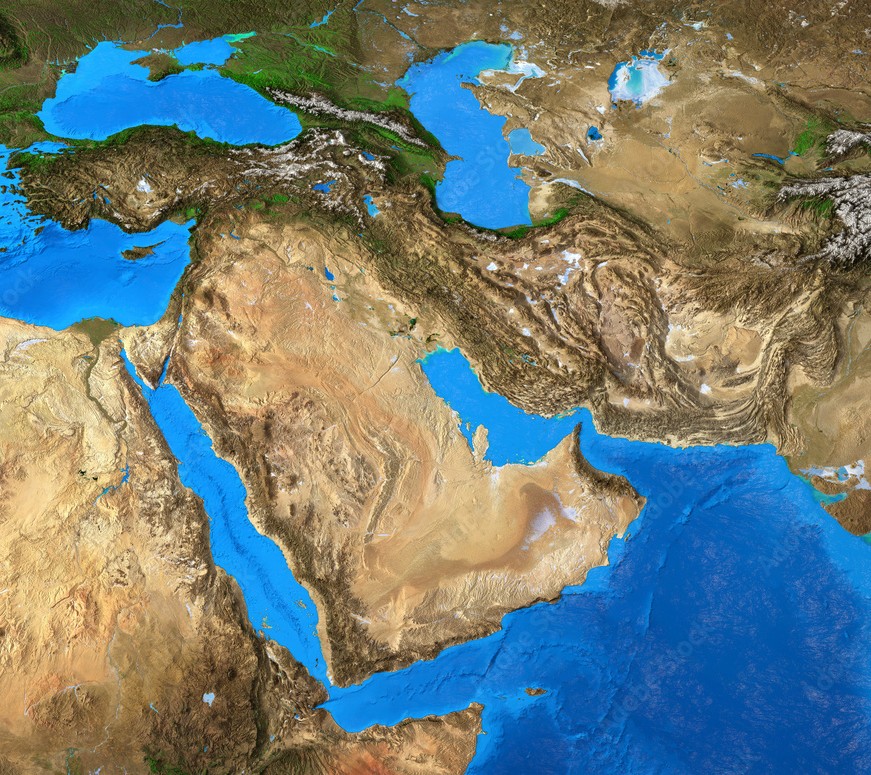
History and geography are inseparable. We cannot understand the physical world—where borders lie, why cities grow, or how resources flow—without examining the power dynamics that created those patterns. Stripped of geographic reality, history becomes little more than a list of dates.
I founded Holistic Humanities to help young people build critical thinking skills—teaching them to pull on these interconnected threads and trace how past events shape our world today.
Mapping the World from London
In geography, one of the most revealing moments occurs when students realise that a sphere has no natural centre, and that every map projection is a deliberate choice. Stand at Greenwich, and you are on the Prime Meridian—an arbitrary line chosen in 1884 to split the globe into East and West.
Terms we use daily, such as “the Middle East” or “the Levant” (derived from the French levant, meaning “where the sun rises”), are physical artifacts of this history. Coined by European traders and cartographers to describe lands lying towards the eastern sunrise, this language anchored Europe as the centre of the map.
This cartographic confidence grew alongside modern nationalism. The 1848 revolutions across Europe—the “Springtime of Peoples”—marked the birth of the nation-state as a dominant ideology, demanding that borders align with linguistic and cultural identities. Following two World Wars and the shift to American global dominance, this European nation-state model was universalised as the global default. Yet across the post-colonial world, these new national borders were drawn along old imperial lines designed for resource extraction rather than local consensus—setting the stage for decades of systemic friction.
Broken Promises and Unravelling Chains
To understand this friction, we must look at the broken promises that helped forge the modern Middle East. During the First World War, Britain dispatched figures like T.E. Lawrence (“Lawrence of Arabia”) to enlist Arab leaders in an uprising against the Ottoman Empire, promising sovereign independence in return. Secretly, through the 1916 Sykes-Picot Agreement, Britain and France drew arbitrary lines across the map to divide the region between themselves.
Imperial influence did not end with borders; it reached into the very symbols of identity. Sir Mark Sykes—co-author of Sykes-Picot—personally designed the four-colour Flag of the Arab Revolt to foster a unified Arab identity against Ottoman rule. That British-designed combination of red, black, white, and green established the Pan-Arab colours, laying the template for the modern national flags of Jordan, Palestine, the UAE, Sudan, and Kuwait.
These interventions set off a long chain reaction across the 20th century:
- 1951–1953: When Iran nationalised its oil, it challenged the Anglo-Iranian Oil Company (rebranded in 1954 as British Petroleum, or BP). Demanding sovereign control over its resources, Iran’s elected government threatened British commercial interests. In response, Britain and the US orchestrated the 1953 coup to depose its democracy and reinstate an authoritarian Shah—a trauma that laid the groundwork for the 1979 Islamic Revolution and decades of regional proxy conflict.
- 1956: This crisis inspired Egypt to nationalise the Suez Canal. Britain’s botched military intervention at Suez shattered its standing as an independent superpower, destabilised the region, and led directly to the 1967 Six-Day War.
- 1967–1971: The 1967 war redrew the regional landscape. In Syria, losing the Golan Heights created a crisis that brought Hafez al-Assad to power in 1970, establishing a military regime that granted Moscow a naval base at Tartus in 1971—the base that enabled Russian intervention in the Syrian Civil War decades later.
- 1967 (Aden & Yemen): That same era saw the end of the British military presence in Aden in 1967. Today, Aden is part of modern Yemen, a nation trapped in one of the world’s worst ongoing humanitarian crises.
The structural vacuum left by imperial withdrawal—compounded by intervention from regional powers like Saudi Arabia—sparked decades of civil war around two critical maritime choke points: the Bab el-Mandeb strait and the Strait of Hormuz. Modern blockades, drone attacks, and tanker seizures on these narrow waterways disrupt global energy supplies, showing how historical betrayals directly drive up fuel prices and cost-of-living pressures in Britain today.
From Physical Empire to Offshore Capital
As its physical empire receded, Britain executed a quiet shift. It replaced industrial output with an “invisible” empire, transforming the City of London and a global network of Crown tax havens into a clearing house for offshore capital—money held abroad to avoid tax.
Viewing these developments in isolation hides their domestic consequences. Britain’s current budget constraints, crumbling infrastructure, and strained public services are not the fault of immigration. They are the direct result of a post-imperial economy reliant on financial speculation over productive investment.
Can History Ever Be Taught in a Vacuum?
We often hear calls for history to be taught neutrally, as if a classroom could exist in a political vacuum. But pretending facts float free of perspective is unhelpful. True humanities education cannot be neutral about human dignity; it requires us to examine how power operates.
I make no secret of my perspective here. Looking at our current political landscape, it is hard not to see alarming parallels with the 1930s—particularly in the unchecked rise of oligarchic wealth, corporate media consolidation, and an alignment of elite interests that reduces complex public anxieties into bitter, binary divisions.
Historically, Britain’s greatest intellectual traditions—championed by independent thinkers and public philosophers who valued radical critique and moral purpose—have always insisted that education must prepare people to question power, not just memorise dates. When we strip away comprehensive understanding, we leave young people vulnerable to lazy scapegoating.
Ultimately, the fragmented way we are taught to see the world is itself a crucial thread to untangle. By helping students pull on these connections, we equip them to look past hollow neutrality, make sense of modern Britain, and think deeply about the future.


Leave a Reply